VUV Laser Development
The excitation energy of the thorium-229 first nuclear excited state is 8.35573(3) eV, which corresponds to a laser wavelength required for its excitation of 148.3821(5) nm [1]. This wavelength falls in the vacuum ultraviolet (VUV) regime, where laser technology is challenging. For the development of a nuclear optical clock, a narrow-band continuous-wave (cw) laser is required.
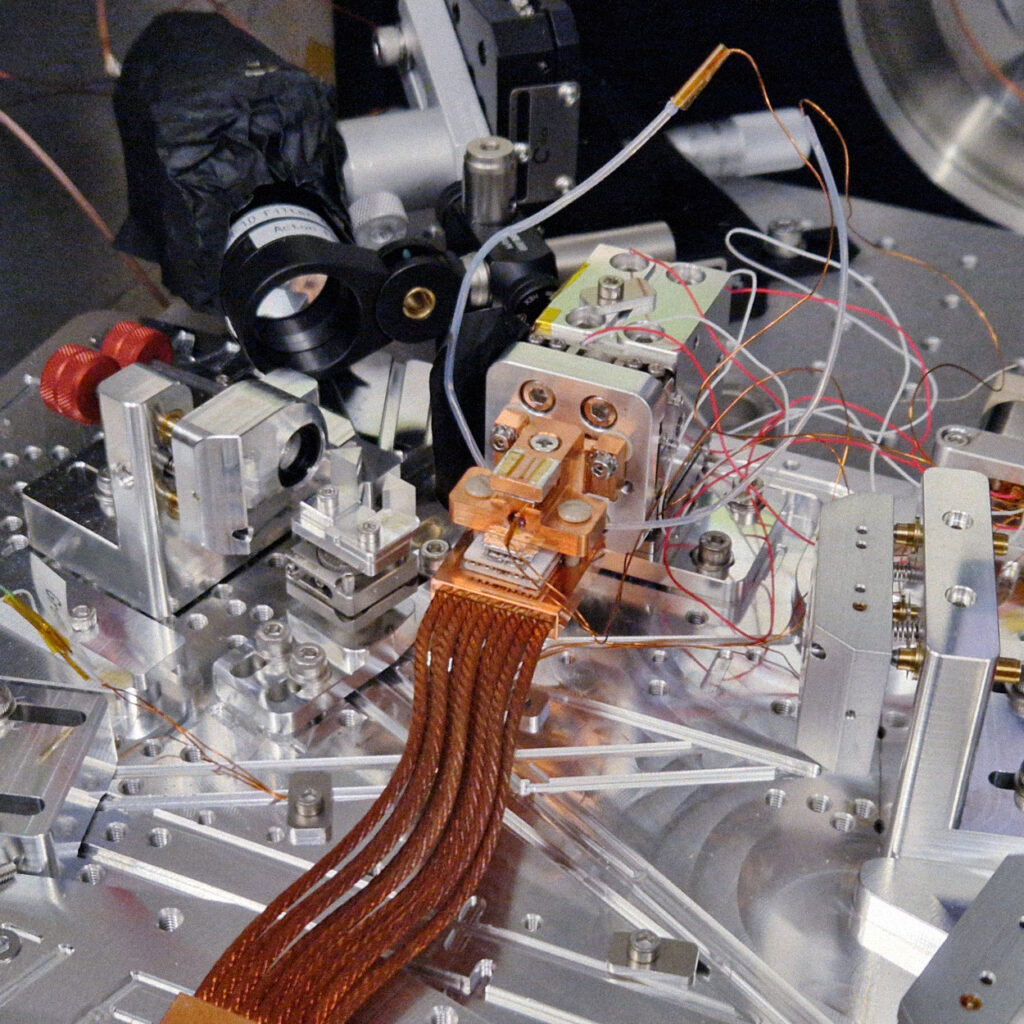
NuQuant studies second harmonic generation (SHG) of a 297 nm laser. However, no material is known where conventional birefringent phase matching is possible. Instead, quasi-phase matching with a periodically poled crystal can be used. BaMgF4 (BMF) is a suitable candidate due to its second-order non-linearity, high VUV transparency, and ferroelectric properties, making it amenable to periodic poling (pp). In order to reach reasonable powers, ppBMF is placed inside an enhancement resonator, and intracavity SHG is performed. The projected powers make it a viable scheme for the realization of a compact all-solid-state CW laser necessary for the realization of a solid-state as well as a single-ion nuclear clock.
[1] Tiedau, J. et al. Laser Excitation of the Th-229 Nucleus. Phys. Rev. Lett. 132, 182501 (2024).